
People ask for a trim when they mean dead wood over the roof, low limbs over the drive, a heavy one-sided crown, or an ornamental sheared into a ball. The cuts are not interchangeable. A good day on an oak is mostly what we leave. This page is the work we do on live trees you intend to keep, and when the honest answer is removal instead.
What a proper prune includes
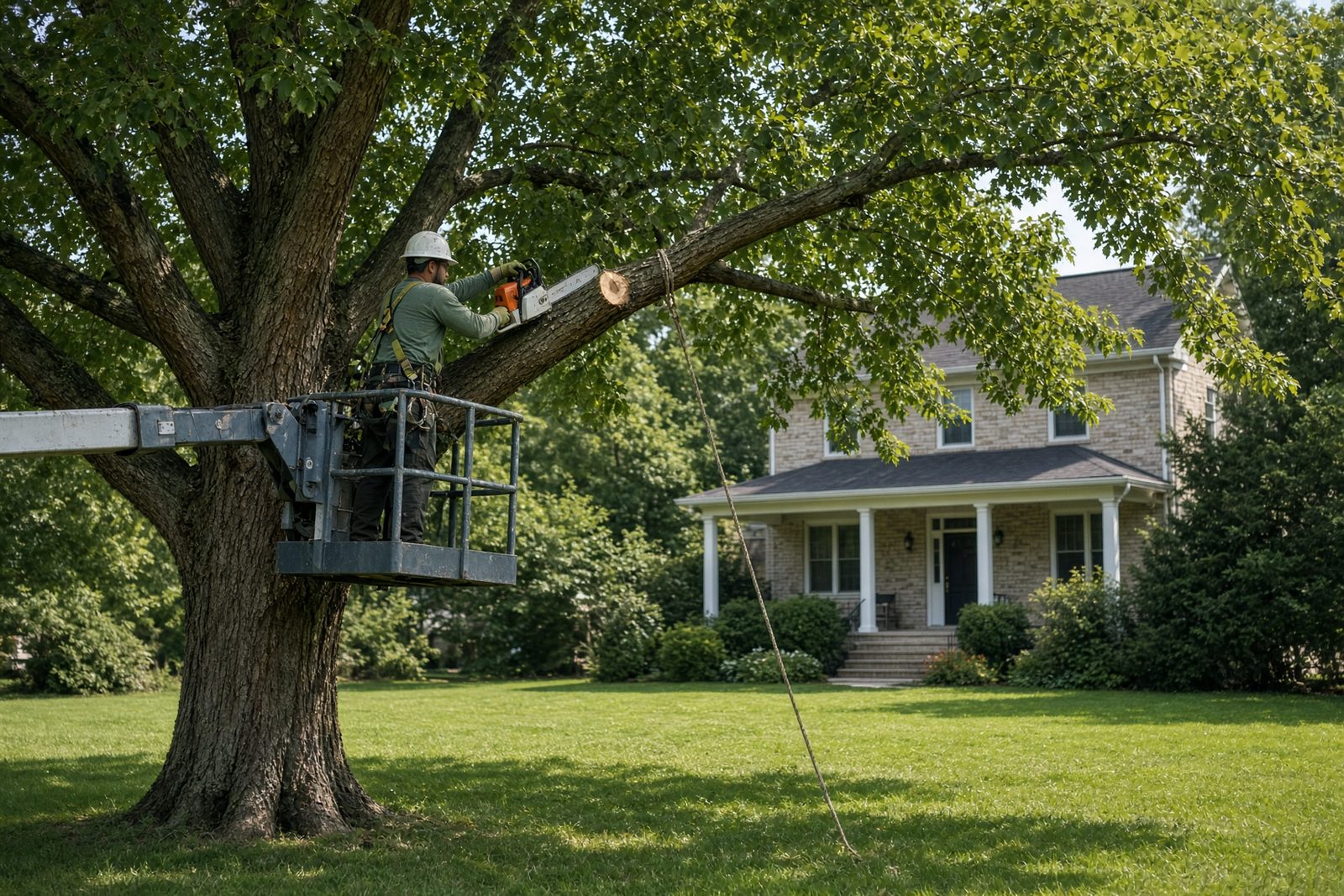
We start from the ground and from the places you use. What is hitting the house? What blocks the drive or the corner? What is dead, cracked, or crossing hard enough to lose bark? A long limb over a target gets weight taken off the end, back to a side branch large enough to take over, not a flush cut at the trunk.
Deadwood, rubbing wood, and broken wood come out. Clearance over a roof is a few feet of raising, not a lion-tail that leaves foliage only at the tips. We do not top. Topping, hat-racking, or rounding over a shade tree leaves stubs that decay and sprouts that fail in the next ice load. If a price depends on making an oak half as tall in an afternoon, that price is for topping. We will not match it.
Pruning will not fix a rotten base or a crown that is mostly dead. In those cases the tree should come down, and we will say so before you spend prune money on a delay.
Oaks, maples, and the timing
Oaks carry older Limerick, Upper Providence, and Phoenixville lots. They respond badly to flush cuts and to pruning in the wrong month. Oak wilt is in Pennsylvania. Our default is to prune live oaks in winter or late summer, outside April through July, when beetles are most likely to carry the disease into a fresh wound. A hanging limb over a bedroom does not wait for that window.
Silver and Norway maples, planted too close to houses from Pottstown through Collegeville, bleed if cut in late winter. The drip looks dramatic and is usually harmless. The cut still has to keep the branch collar. Cutting flush removes the tissue that closes the wound. Leaving a stub is the other mistake.
White pine is mostly cleanup of storm-broken leaders. Shearing a pine into a rectangle ruins it. If the root plate has lifted, stop thinking about pruning and read the removal page.
Japanese maples and serviceberry
Japanese maples in front beds are usually hurt by impatience. A hard shear into a lollipop exposes bark to sunscald and destroys the layered habit. The useful work is thinner: rubbing twigs out, a congested interior opened so air moves, and a branch on a walk shortened back to a twig that points the right way. Late winter, or just after the spring flush hardens, is the time. Not the heat of July.
If the maple is simply in the wrong bed, a young one can often be moved. An old specimen with a good trunk is usually worth pruning in place.
Serviceberry, Amelanchier, is the small native tree with white April flowers and June fruit. It shows up in Limerick and Collegeville beds and at the edge of older woods. Raise a few low stems if they block a walk, thin crossing stems after flowering, and leave the vase. Cedar-quince rust can speckle the fruit. On a backyard tree grown for flowers, that is a mess more than a death sentence. We are not a spray company, and we will not sell a season of applications for cosmetic rust.
How often, and what we will not call pruning
A mature shade tree pruned well does not need a visit every year. Every three to five years is plenty for most oaks and maples unless a storm intervenes. A tree someone else topped may need a shorter cycle while weak sprouts are thinned. We do not run a monthly route.
Young trees are the opposite. A short structural prune in the first five years prevents the double leader you will otherwise pay to remove over the roof. Ask for that visit if we just moved a tree or you just planted. A backyard apple can get a light late-winter prune. We are not an orchard service. If the tree is a thicket untouched for a decade, we thin toward something you can reach, or we say it should come out.
We will not strip one side of a crown so the tree looks like a flag. That is how trees fail. A limb across the line can be shortened correctly, with your okay and, if we stand on their ground, with theirs.
What you will see when we leave
Cuts are at the collar or back to a lateral. The lawn is raked. Small wood is chipped or hauled as agreed. A prune does not include stump grinding, because the tree is still standing. The crown will look thinner, not shorter by half. If you wanted it half as tall, we need that conversation before the bucket goes up, because the answer may be removal and a better species.
Questions about pruning
How much can you take off?
We stay at or under about a quarter of the live crown in one year, and usually less on an old oak. If the tree is far too big for the space, pruning cannot make it a small tree.
Will pruning stop the leaves?
No. It can keep a limb out of the gutter. It will not make an oak tidy. If zero debris is the goal, the honest job is removal, then a smaller tree farther from the roof.
Do you prune hedges?
We prune trees, including multi-stem serviceberry and Japanese maple. A formal hedge on a shearing schedule is a landscape visit, and we will say if that is all the property needs.