

Spring City sits on the Chester County bank of the Schuylkill, opposite Royersford, with Main Street at the bottom and houses stepping up the hill. The bridge makes it a short trip from Limerick even though the county line is the river. We come for tree removal, pruning and trimming, stump grinding, and transplanting young trees that are in the way of a real project. The work is not identical to a flat Limerick lawn, and the estimate should show why.
Hills, maples, and the drop zone
A tree on the uphill side of a Spring City house can fall farther than its height suggests, and a tree on the downhill side wants to go through the neighbor's roof if nobody rigs it. We piece these down. A clear fell is uncommon once the slope, the steps, and the parked cars are counted. Climbing is normal. A bucket truck works when the street is level enough and the crown faces the curb. If the only set-up is a steep drive, we may keep the truck on the street and walk the brush down. That takes longer. It also keeps a heavy machine off a drive that was not poured for it.
Older maples and a scattering of oak, plus declining ash, are the shade trees. The prune-or-remove test is the same one we use in Limerick: sound trunk and a clearance problem means prune; hollow base, a fresh lean, or a crown that is mostly dead means remove. Live oaks are pruned in winter or late summer, not in the April-through-July oak wilt window, unless we are taking a hazard limb. Ash comes down while it can still be tied into safely.
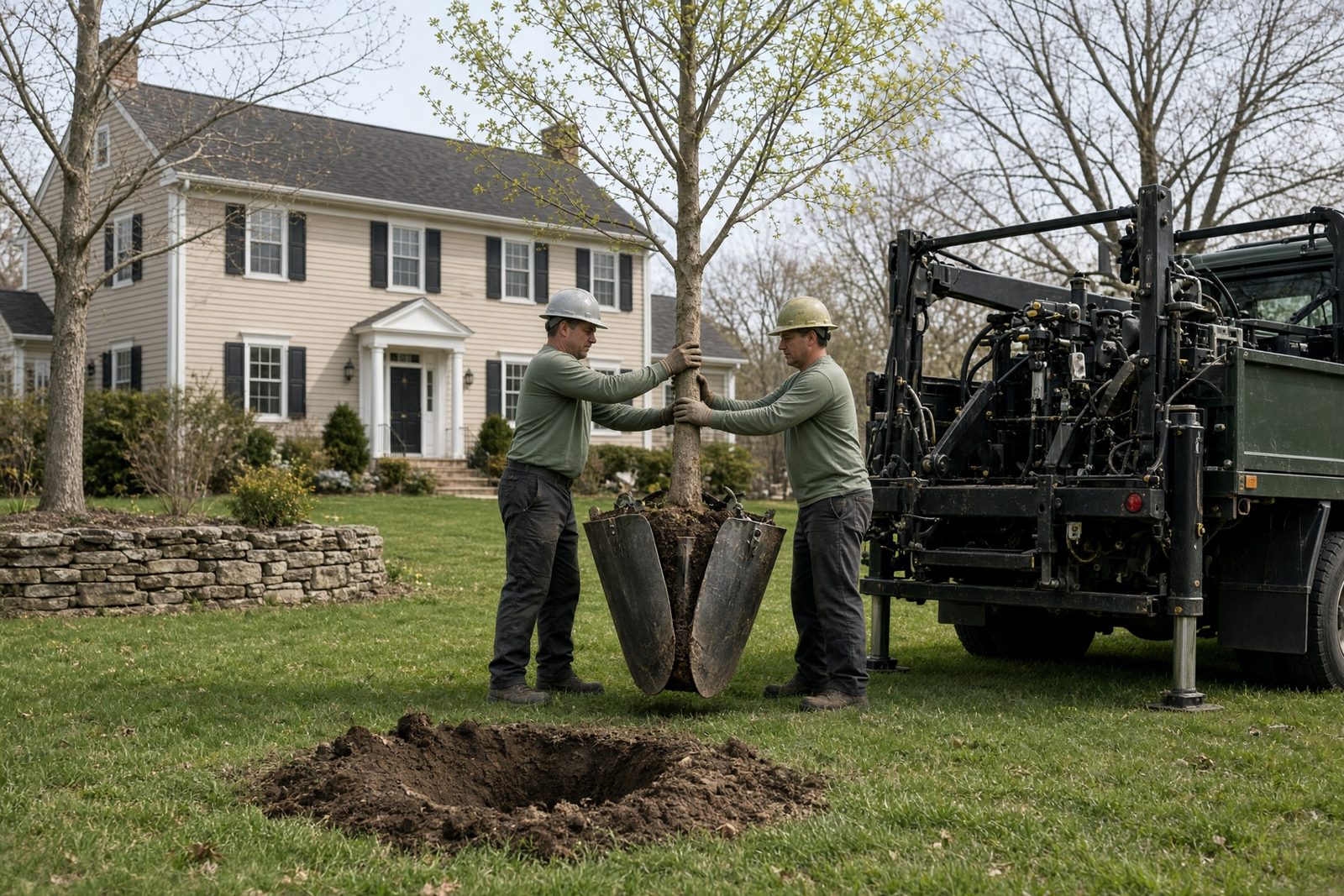
Callery pears on the newer infill lots split at bad forks. Removal is appropriate when the trunk has opened. Replacing them with another pear repeats the story. A serviceberry or a young oak already on the lot is sometimes a move candidate in spring or fall. A mature hillside oak is not. We will not quote a crane-and-spade spectacle for a tree that should be pruned or removed.
Stumps, walls, and wet ground
Retaining walls and stone steps complicate grinding. The wheel needs a stance that does not load the top of a wall or sit on the capstones. Some stumps can be ground from the uphill side. Some should be left if the root is part of what is holding soil, and we will say that rather than undercut a slope you need. Where the lawn is flat enough, we grind below grade for seed and chase the flare roots that would wreck a mower. Chips are usually hauled on these lots because there is no place to age a pile. Read the stump grinding page for what stays in the ground. A grinder is not an excavation of every root.
Near the river the yard stays wet. We will move a grind or a removal off a soaked day if the ruts would be worse than waiting a week. Hazard trees on a house do not wait for perfect turf. Cosmetic stumps do.
Flag the walls, the downspout leaders, and any line you added to a basement. Public utilities are located when we are near the street. The narrow alley access that shows up on the older blocks is a walk-behind grinder conversation. Measure the opening, hinges included, and put it in the form.
The rest of the week
From Spring City we are often in Phoenixville the same day, or back across the bridge into Royersford and Limerick. Pottstown is upriver. Collegeville is the other direction. If your address is in East Vincent or East Coventry, just outside the borough, call anyway. If we are too far, we say so.
Phone (610) 860-4798, email info@limericktreeservice.com, or the form. Photos of the whole tree from downhill, so we can see the roof it leans toward, are the useful ones. Hours are Monday through Friday, 7:00 a.m. to 6:00 p.m., Saturday 8:00 a.m. to 3:00 p.m. Sunday is for trees on structures and blocked drives after a storm, not for routine quotes. Japanese maples and serviceberry on the terraces get a light hand, the same standard we publish on the pruning page: thin and raise, do not shear, and do not move them in a heat wave.
Questions from Spring City
Can you lower wood without crossing the neighbor's steps?
If the rigging can stay on your side, yes. If the safe path crosses their steps or their roof edge, we need their yes before the day, not a wave from the porch as the limb is already cut. Tight hillsides are where that conversation matters most.
Do you handle trees that fell onto the roof in a storm?
Yes. Those calls go first. We take the wood off so the roof can be seen. We do not replace shingles or fix slate. Say "on the house" when you call so it is not sitting in the same list as a stump from last year.
Is the borough tree at the curb included?
Only with the borough's permission. We will not remove a street tree because the roots bumped a sidewalk unless the owner of that tree has agreed. Trees inside your fence are a different question, and an association rule can still apply.
How do I know if the hillside tree should be pruned instead?
If the trunk is solid and the problem is a limb reaching the roof, pruning is usually enough. If the soil is cracking on the uphill side and the tree has started to lean, send photos and we will look before anyone climbs. A fresh lean on a slope is not a trim.