

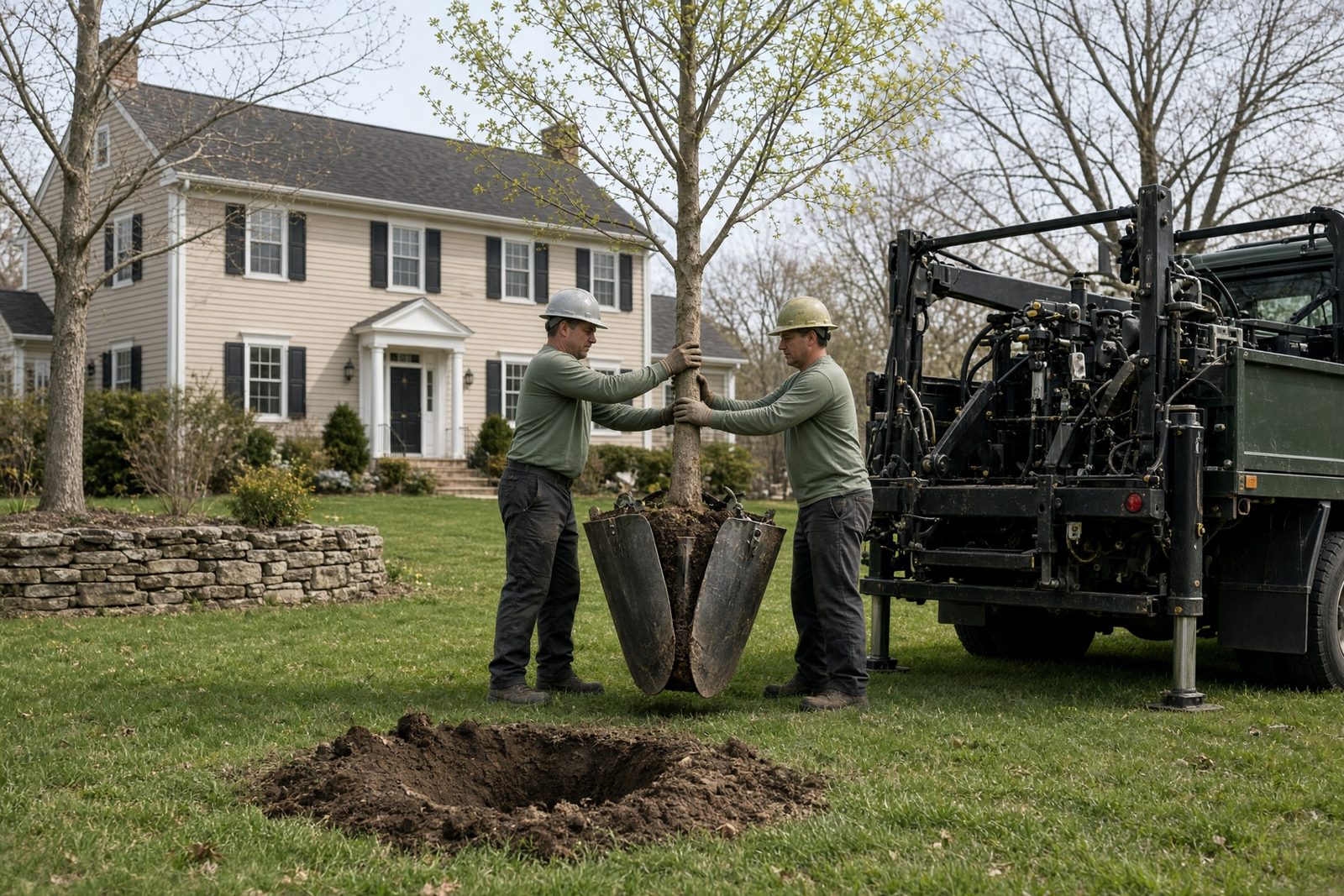
The usual call: the tree is fine, but it is under the addition, three feet from a foundation, or in a row that is now the driveway. Cutting it is the fast answer and sometimes the wrong one. If the trunk is still small, the tree is healthy, and you have a better spot on the same property, a move can be the job. If the tree is hollow or simply too large, read tree removal. If it can stay and only needs clearance, start with pruning.
Which trees are worth moving
A good candidate is healthy and still a diameter the machine or the crew can ball. A truck-mounted spade often handles shade trees under roughly six to eight inches, and only if the spade can reach. Tight side yards in Royersford or Phoenixville fail that test even when the trunk is the right size. A dug, burlapped ball works for smaller ornamentals and for some trees the spade cannot approach. A dinner-plate of roots on a tall tree is not a transplant. It is a slow removal.
Species we move here include young red and sugar maples that are not already girdled, small white oaks and red oaks, serviceberry, dogwood, and Japanese maples that have not spent twenty years in a cramped bed. Young pines can move if the ball stays intact. A large white pine is a poor bet. Ash is not worth moving. Emerald ash borer makes relocating one a way to spend money on a problem.
We decline a move when the tree is in decline, when the roots sit in a septic field, or when the new spot is six feet away with the same soil problem. Moving a tree from a bad site to another bad site wastes the tree's stored energy. We would rather say no.
Season, spade, and the hole
Reliable windows are early spring before bud break, and fall after leaf drop while the soil can still be worked. Summer moves of anything larger than a small ornamental are a last resort on a Limerick ridge in a heat spell. Frozen ground stops everybody.
A tree spade cuts a cone of soil and lifts the tree upright. We do not shake the soil off to make it lighter. The receiving hole is a little shallower than the ball is tall, so the root flare sits at grade or a touch high. Planting deep is the most common way a moved tree fails two years later.
A burlapped ball is for trees the spade cannot reach. Burlap and any wire basket get cut off the top and sides once the tree is in the hole. Leaving a basket as a cage is how roots girdle.
The new spot and the aftercare
The new location needs the light that species wants, room for the mature crown, and soil that drains. A Japanese maple that fried on a south wall will fry on another south wall. Do not set a young oak in a four-foot pit between the walk and the porch. Look up, so we are not moving a tree from under a service drop to a spot under the primary line. Look down. Public utilities can be located. Your irrigation, the line to the shed, and the septic are yours to flag.
We water the ball in on the day. The next two summers are yours. A deep soak once or twice a week, when rain does not come, beats a five-minute sprinkle on the leaves. Check the soil under the mulch with your hand. If it is cool and damp a few inches down, skip a week. If it is dry and the leaves flag by noon, water that evening. Mulch in a donut, pulled back from the trunk. Do not fertilize a fresh move hard. Stakes only if the site is windy, and the ties come off after a season.
Thin foliage the first summer can be normal stress, especially on oaks and Japanese maples. A tree that leafs out late and then holds those leaves is usually settling in. A tree that never breaks bud the second spring should be looked at before you assume the move failed for a reason you can still fix. Watering and planting depth are the two we can still see. Some transplanted trees die even when both were right. We promise a ball sized to the trunk, a flare at the right height, a fair season, and a clear no when the tree is a bad candidate. We do not promise biology. If you cannot reach the new spot with a hose, say so before we dig. A stump grind is the epilogue if a different tree came down the same week. It should not be a surprise.
Questions about transplanting
Can you move a full-size oak?
Almost never as a reasonable project. The ball is enormous, the access rarely exists, and the odds do not justify it. We prune large oaks or remove them. We move younger trees.
Do you warranty the tree?
We stand behind the workmanship and behind an honest refusal. Watering after we leave is the largest factor you control. A drought with no water on the ball will kill a tree that was moved correctly.
Is fall or spring better here?
Both work. Spring, before the buds open, is easier to water into the season. Fall, after leaf drop and before a hard freeze, lets roots grow in cool soil. We avoid the week of a heat wave for any trunk you cannot wrap your hands around.